Introduction
For most of the past two decades, India's tax-exempt employee allowance limits barely changed. Meal reimbursements are capped at ₹50 per meal. Children's education support is stuck at ₹100 per child per month. Car benefit limits set in an era when fuel cost less than half what it does today. The new Income Tax Rules 2026, notified by India's Ministry of Finance in March 2026, fundamentally change this picture. From April 1, 2026, several key allowance categories have been revised upward — in some cases by 30 times the previous limit. The result: employees can now take home significantly more from the same CTC, and employers can restructure compensation without spending an additional rupee on payroll. This guide explains every change, who benefits most, and what HR teams need to do right now.
What Are Flexi Benefits?
A flexi benefit — also called a flexible allowance or tax-exempt allowance — is a component of an employee's Cost-to-Company (CTC) that is disbursed as a specific allowance rather than taxable salary. Because these allowances are legally exempt from income tax under the Income Tax Act 1961 (up to prescribed limits), they reduce the employee's taxable income without reducing the employer's total compensation outlay. Think of it this way: if an employee earns ₹80,000 per month as gross salary, and ₹10,000 of that is structured as tax-exempt meal and fuel allowances, they pay income tax only on ₹70,000 — saving potentially thousands of rupees each month, depending on their tax slab. Get Flexi-Benefit Card
Flexi benefits typically cover:
- Meal allowances — daily food and beverage expenses at work
- Fuel and car maintenance reimbursements — for employees using personal or company vehicles
- Children's education allowances — tuition and school-related expenses
- Hostel allowances — for employees in employer-supported accommodation
- Gift vouchers — periodic gifts from employers
- House Rent Allowance (HRA) — for employees paying rent.
Key Principle: Flexi benefits are not a tax loophole — they are an explicitly legislated, fully compliant mechanism under Indian income tax law. Employers who fail to structure CTC around these exemptions are effectively leaving money on the table for their employees.
What Changed Under the New Income Tax Rules 2026?
The Ministry of Finance notified the revised Income Tax Rules 2026 in March 2026, with all changes effective from April 1, 2026. Below is a complete, side-by-side breakdown of every allowance category that has been revised:
| Allowance Category |
Old Limit |
New Limit (Apr 2026) |
Monthly Gain |
Annual Impact |
| Meal Allowance |
₹50 / meal |
₹200 / meal |
+₹3,000/mo |
+₹36,000/yr |
| Gifts & Vouchers |
₹5,000 / year |
₹15,000 / year |
— |
+₹10,000/yr |
| Car Benefit (below 1.6L engine) |
₹1,800 / month |
₹5,000 / month |
+₹3,200/mo |
+₹38,400/yr |
| Car Benefit (above 1.6L engine) |
₹2,400 / month |
₹7,000 / month |
+₹4,600/mo |
+₹55,200/yr |
| Driver's Salary Reimbursement |
₹900 / month |
₹3,000 / month |
+₹2,100/mo |
+₹25,200/yr |
| Children's Education Allowance |
₹100 / child per month |
₹3,000 / child per month |
+₹2,900/child |
+₹34,800/child/yr |
| Hostel Allowance |
₹300 / month |
₹9,000 / month |
+₹8,700/mo |
+₹1,04,400/yr |
Biggest Change: The children's education allowance sees the steepest rise — from ₹100 to ₹3,000 per child per month (a 30× increase). For an employee with two children, this alone adds ₹72,000 annually to their tax-free income, up from just ₹2,400.
Flexi Benefit Limits Before & After — April 2026
The visual below summarises every revised allowance category, the before-and-after limits, and the maximum combined tax-free benefit available to an employee who fully utilises all categories.
India's Flexi Benefit Allowances: Before vs. After
All revised limits under the new Income Tax Rules 2026 — zero additional payroll cost for employers. 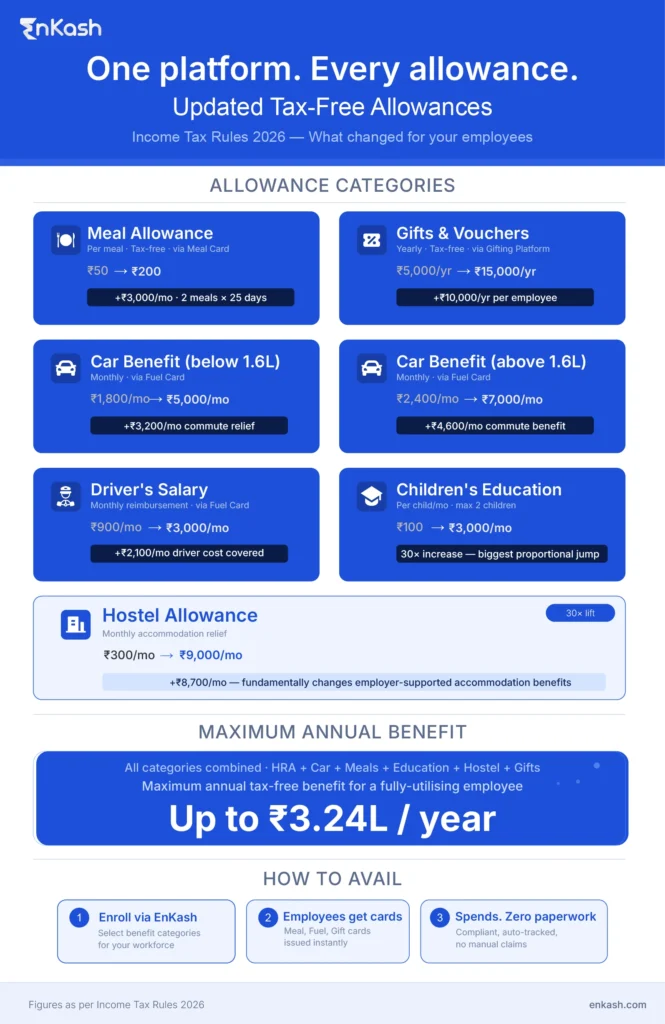
Claim Every Revised Allowance Through One Platform — EnKash
Understanding what changed is only half the equation. The real question is: how does your organisation actually disburse these allowances in a tax-compliant, paperless, and audit-ready way? EnKash gives HR teams a single platform to issue and manage every category of flexi benefit — meal, fuel, and gifting — through purpose-built financial instruments that are accepted everywhere and require zero manual claims.
EnKash Meal Card
The EnKash Meal Card is a dedicated prepaid card loaded with your meal allowance each month. Employees spend it at restaurants, cafeterias, food delivery platforms, and grocery stores — anywhere food is purchased. With the new ₹200-per-meal limit under Income Tax Rules 2026, companies can now load significantly higher meal balances without any tax liability on the employee.
- Accepted at all RuPay food merchants — online and offline
- No bill uploads or reimbursement claims — spend, and it's done
- 100% tax-exempt under Section 17(2) of the Income Tax Act
- HR dashboard shows real-time balance, usage, and compliance reports
- Annual saving potential per employee (30% slab) Up to ₹32,400/yr
- Tax-Free Meal: Up to ₹200/meal
Give your employees Rs. 1 lakh+ in Savings with EnKash Meal Card
EnKash Fuel Card
The revised car benefit limits under Income Tax Rules 2026 raise the monthly tax-free ceiling for vehicle use to ₹5,000 (below 1.6L engine) and ₹7,000 (above 1.6L engine). The EnKash Fuel Card is the most practical way to disburse and track this allowance — employees use it at petrol pumps and for vehicle maintenance expenses, while HR monitors spending and controls limits from a central dashboard.
- Accepted at all major fuel stations across India — HPCL, IOCL, BPCL, and private pumps
- Set spend limits per employee or vehicle category to align with revised IT limits
- Auto-categorises fuel transactions for clean payroll reporting
- Covers driver's salary reimbursement (up to ₹3,000/month) on the same card
- Annual saving potential per employee (30% slab)Up to ₹30,240/yr
Ready to fuel your savings? Explore EnKash Fuel cards
EnKash Gift Cards & Vouchers Solution
With the gifts and vouchers exemption limit tripling from ₹5,000 to ₹15,000 per year under the new tax rules, employers now have significantly more room to reward employees tax-efficiently. EnKash's gifting platform lets HR teams issue digital gift vouchers across 500+ top brands — from e-commerce to dining, fashion, and entertainment — all within the new tax-free ceiling and with full compliance built in.
- 500+ brand vouchers: Amazon, Flipkart, Swiggy, Myntra, BookMyShow & more
- Bulk issue on occasions — Diwali, birthdays, work anniversaries, performance rewards
- 100% digital — instant delivery via email or SMS, zero physical handling
- Auto-tracks annual gifting per employee so you never cross the ₹15,000 tax-free ceiling
- Annual tax-free gifting limit (tripled from ₹5,000) ₹15,000/yr per employee
Explore EnKash Gifting Platform →
One Card. One Dashboard. Every Flexi Benefit Covered.
EnKash's multi-wallet prepaid card consolidates all revised flexi benefit allowances onto a single instrument. Meal, fuel, gifts, hostel, and education allowances — each in a separate wallet on the same card, each transacted at the right merchant category, each automatically compliant with the Income Tax Rules 2026. HR teams manage every benefit from one dashboard. Employees carry one card for everything.
- 5,000+ Businesses on EnKash
- 100% RBI-compliant platform
- ₹0 Additional payroll cost
- Zero Bill upload required
Schedule a Free Consultation. Explore All Prepaid Cards
How It Works: From CTC to Take-Home in 4 Steps
01. HR Restructures CTC
HR and Finance teams model the CTC split, shifting taxable components into revised exempt allowances using the 2026 limits — zero cost change.
02. EnKash Configures Wallets
Each employee's multi-wallet card is set up on the EnKash dashboard with the correct allowance limits per category and per employee grade.
03. Employees Spend Freely
Each wallet is restricted to its eligible merchant category code — meal wallets at food merchants, fuel wallets at pumps. No misuse possible, no claims needed.
04. Payroll Closes Cleanly
Transaction data flows back into the payroll system. Every allowance is auto-categorised, tax-exemption is applied correctly, and Form 16 is accurate.
The HRA Update: Four New Cities Added to 50% Tier
One of the most impactful structural changes in the Income Tax Rules 2026 concerns the House Rent Allowance (HRA) exemption. Previously, only four metro cities — Mumbai, Delhi, Chennai, and Kolkata — qualified employees for the higher 50% HRA exemption category. All other locations were capped at 40%.
New Cities in the 50% HRA Exemption Category
Under Income Tax Rules 2026, these four cities now qualify for the same 50% HRA exemption tier as Mumbai and Delhi — a meaningful upgrade for their salaried workforce paying premium rents.
- Bengaluru
- Pune
- Hyderabad
- Ahmedabad
For an employee renting in Bengaluru with a basic salary of ₹80,000 per month, the upgrade from 40% to 50% HRA exemption can add ₹8,000–₹12,000 annually to their tax-free income — purely from this reclassification, without any other changes.
Who Benefits Most from These Changes?
Not every employee gains equally from the revised allowances. Actual tax savings depend on which allowances are already in the CTC, the employee's income tax slab, and which tax regime they have opted into.
High-Impact Employee Profiles
- Employees with two school-going children: The education allowance hike from ₹100 to ₹3,000 per child per month means an additional ₹69,600 per year in tax-free income for parents of two children.
- Mid-senior professionals using a company car with a driver: Combined car benefit and driver's salary revisions can add over ₹80,000 annually to tax-exempt income.
- Salaried professionals renting in Bengaluru, Pune, Hyderabad, or Ahmedabad: The shift to the 50% HRA tier directly improves their exemption ceiling, particularly impactful at higher rent and salary levels.
- Employees in employer-supported hostels or shared accommodation: The hostel allowance revision from ₹300 to ₹9,000 per month is transformative — equivalent to adding ₹1.04 lakh to annual tax-free income.
- Employees in the 30% income tax bracket: Higher-slab earners see the largest absolute rupee saving from each allowance category since they lose more per rupee of taxable income.
What HR & Finance Teams Should Do Before April 2026
Employers who restructure CTC components before April 1 allow employees to benefit from revised limits from the start of FY 2026–27. Every month of delay translates directly into foregone tax savings for employees.
Audit Existing CTC Structures
Review which employees currently have meal, car, education, and hostel allowances — and at what limits. Identify the gap between current allocations and the new permissible maxima.
Model CTC Restructuring Scenarios
For each role band, calculate how shifting taxable salary into revised exempt allowances changes take-home pay. Validate that total CTC remains constant — this is cost-neutral for the employer.
Update Payroll Software and HR Policies
Ensure your payroll system reflects the new allowance limits for April 2026 salary runs. Update internal HR policy documents to reference the 2026 rules explicitly.
Communicate Clearly to Employees
Many employees don't understand how flexi benefits affect their net pay. A clear communication explaining what's changing and how their April payslip will look builds trust and reinforces employer value.
Deploy a Multi-Wallet Card Platform
Purpose-built multi-wallet prepaid cards handle meal, fuel, and gift allowances through a single instrument accepted at all Visa/RuPay merchants — with built-in transaction-level compliance, no bill uploads required. Compliance Note: The revised allowance limits are effective from April 1, 2026. Employers can restructure existing CTC without issuing formal salary revision letters (since total CTC is unchanged). However, best practice is to issue an updated compensation structure addendum for recordkeeping and to document the change for each employee.
Conclusion
India's Income Tax Rules 2026 represent the most meaningful revision to employee allowance limits in a generation. The changes are not incremental — meal allowances have quadrupled, children's education relief is 30 times higher, and four major cities housing millions of salaried professionals have been upgraded to the premium HRA tier. For employees, the opportunity is concrete and immediate: a well-structured CTC can now deliver significantly more take-home pay from the same employer spend. For HR and finance teams, the window to act is April 1. Those who move early give their employees a full year of higher in-hand salary — a tangible, cost-free retention and satisfaction lever that most organisations cannot afford to ignore. The question isn't whether to restructure. It's how quickly you can do it before the financial year begins.